Content feed
Anonymous posts, questions, and reflections. Algorithm surfaces relevant emotional needs without forcing identity disclosure.
UX Research, Product Design & Entrepreneurship · 2024–2025
Mental health for the rest of us. A stepped-care platform I founded to bridge the gap between cheap self-help content and expensive therapy, built as a full Next.js MVP and pitched at two Lisbon startup programmes.
01 · Context & Problem
Most mental health products sit at two extremes: cheap mass self-help (books, TikTok, Pinterest) or €60-per-hour therapy with someone you barely know. There is almost no gradient of care between them.
People who need help often try, fall, and quit before they ever reach a therapist. The steps to mental wellness break halfway. Hopli started from a simple question: what if we could rebuild those steps so people could find hope to try again?
The market gap is structural. Users have little control over the journey. If they don't click with a therapist, it costs another session just to try again. Psychology lacks system-level solutions that bridge intent, knowledge, and guided change.
Core insight: people don't need to be pushed into professional therapy from day one. They need a path they can actually take, through content, guided self-help, and social proof, until trust, habit, and readiness emerge on their own.
02 · Inside the Product
I designed and built the full platform in Next.js with Supabase auth, RLS, and a component system in shadcn/ui. Screens below are captured from the production build at 16:9. The cover mockup shows desktop and mobile adaptation side by side.
03 · Founder Insight
I've seen behind the curtain: therapists' motivations, users' hesitations, and how the system often rewards professional convenience over client outcomes. Hopli doesn't blindly praise mental wellness services. It questions, restructures, and rebalances incentives in favour of users.
As a registered psychologist (License No. 28725, OPP) with UX and product strategy experience, I could translate clinical insight into interface decisions: anonymous posting for stigma, async chat instead of live sessions, and a feed that feels like social media rather than medical onboarding.
"A lot of people need and feel the need of getting help, but they don't see a way in. I want to fix the steps so they can find hope to try again."
Hopli was created to rewire how people engage with emotional growth. It builds the steps they can take before they feel ready for a therapist, and gives therapists tools to reach them earlier through guided self-help.
04 · The Pitch Deck
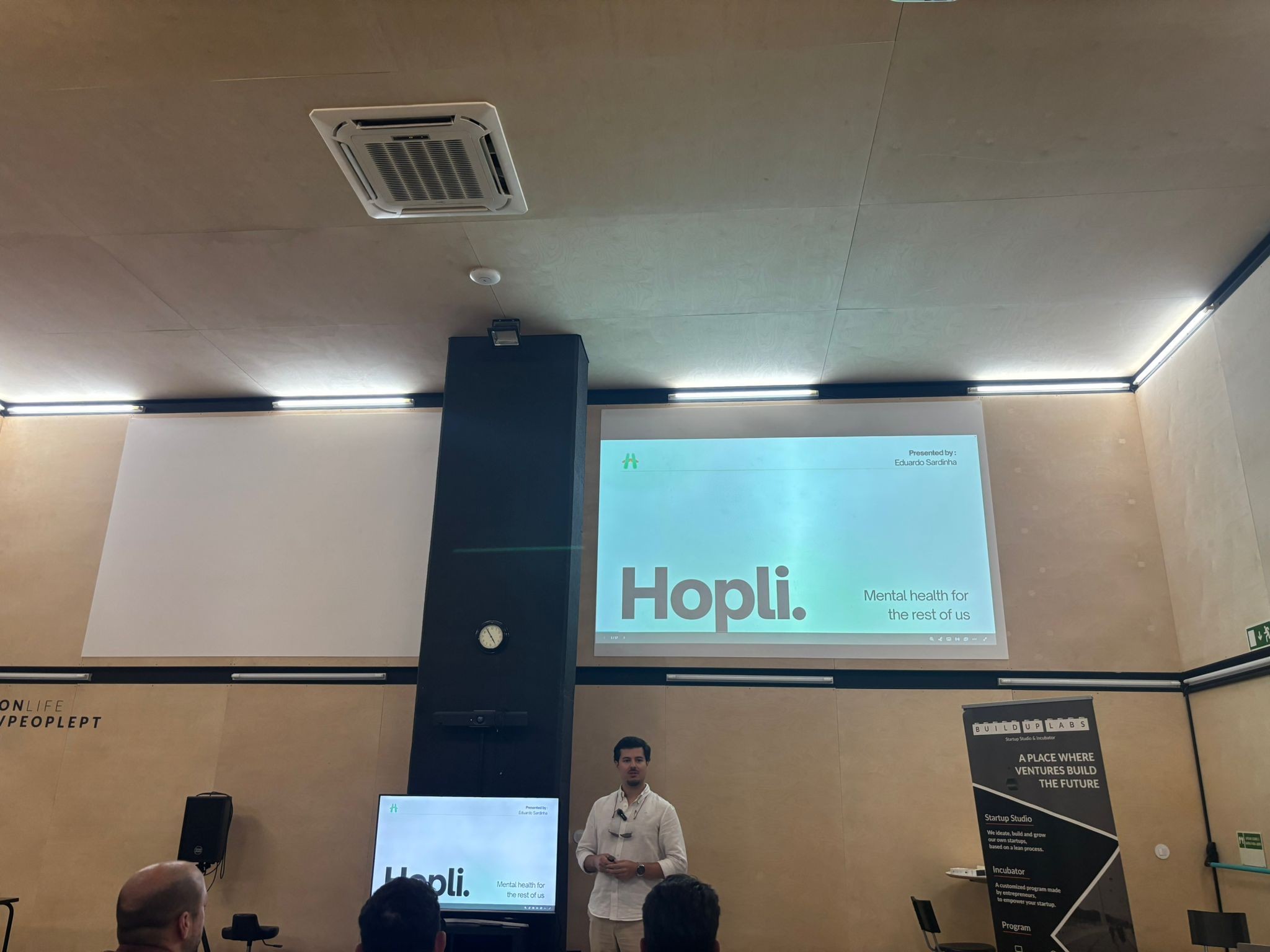
A separate artifact from the product itself: the deck I designed and presented at Build Up Labs Demo Day and Lispolis Ignite. It carries the full story, from the help-seeking gap to the business model, market size, and the ask. Same brand language as the app, built to be defended in front of a jury.
05 · The Solution
Think Instagram + Notion + BetterHelp, but non-judgmental, layered, and user-first. A personal trainer for the mind.
Anonymous posts, questions, and reflections. Algorithm surfaces relevant emotional needs without forcing identity disclosure.
Worksheets, courses, and exercises (CBT, ACT, psychoeducation) assigned around personal goals with progress tracking.
Smart suggestions link feed content to actionable to-dos. Journal entries attach to goals with streak and completion metrics.
Asynchronous messaging with AI or real therapists. Chat embeds posts, goals, and worksheet completions as shared context.
Tinder-style discovery for users; therapists manage preferences, client requests, and an accepting-clients toggle.
Layered access from self-help to guided help to full therapy, with context, trust, and psychological literacy already built.
Scroll videos, posts, questions, and reflections. The algorithm identifies relevant emotional needs without demanding commitment.
Worksheets, exercises, and journal prompts appear based on what resonates. Users take action on their terms.
Match with a therapist, start async chat, or continue with AI. Therapists use in-app tools and templates to guide goals.
Self-help → guided help → full therapy. Every step is frictionless. Every action builds trust for the next.
06 · Two-Sided Design
Most competitors (BetterHelp, Headspace, Calm) are binary: all-in therapy or light content apps. Hopli introduces the missing mid-layer of guided self-help, plus a crowdsourced content model with therapist vetting.
07 · Entrepreneurship
Hopli went through Startup Essentials at Build Up Labs (my first startup programme and first pitch to investors) and Lispolis Ignite, a healthtech acceleration programme focused on innovation in healthcare. Both pushed the product from idea to demo-ready MVP.
Weeks of market validation, prototyping, and mentor sessions culminating in Demo Day at HOOD Lisbon. I pitched Hopli's stepped-care vision to a jury of investors. First time pitching to investors, first time in a structured startup programme.
Selected for the 3rd edition alongside eight other healthtech startups. Intensive bootcamp covering digital health, investment readiness, legal/GDPR, and speed mentoring. Final Demo Day pitch to a jury of healthtech investors and clinicians.
08 · Outcome & Learnings
Hopli reached a working MVP with auth, content feed, goals, worksheets, chat, matching, notifications, and a professional dashboard. I ran early pilots, opened a waitlist, and pitched twice in Lisbon's startup ecosystem.
The product taught me what MoodOS also surfaced: mental health platforms fail on focus, not ambition. Hopli's breadth (feed + journal + courses + chat + matching + therapist tools) was strategically right but operationally heavy for a solo founder. The stepped-care thesis remains; the next iteration would start with one wedge and expand from validated retention.